| Image | Date | Photographer | Location | Technique | Possessor | Notes |
 | 1846 or 1847 | Nicholas H. Shepherd | Springfield, Illinois | Daguerreotype, quarter plate[2] | Library of Congress | This daguerreotype is the earliest confirmed photographic image of Abraham Lincoln. It was reportedly made in 1846 past Nicholas H. Shepherd shortly later on Lincoln was elected to the U.s.a. House of Representatives. Shepherd's Daguerreotype Miniature Gallery, which he advertised in the Sangamo Periodical, was located in Springfield over the drug store of J. Brookie. Shepherd also studied constabulary at the constabulary function of Lincoln and Herndon.[3] |
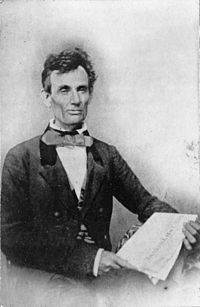 | October 27, 1854 | Johan Carl Frederic Polycarpus Von Schneidau[4] | Chicago, Illinois | Gelatin silver print of a presumed lost daguerreotype[5] | Library of Congress | The 2nd earliest known photo of Lincoln. From a photograph owned originally by George Schneider, erstwhile editor of the Illinois Staats-Zeitung, the nearly influential anti-slavery High german newspaper of the West. Mr. Schneider first met Mr. Lincoln in 1853, in Springfield. "He was already a man necessary to know", says Mr. Schneider. In 1854 Mr. Lincoln was in Chicago, and Isaac N. Arnold invited Mr. Schneider to dine with Mr. Lincoln. After dinner, equally the gentlemen were going down town, they stopped at an itinerant photograph gallery, and Mr. Lincoln had this picture taken for Mr. Schneider.[six] |
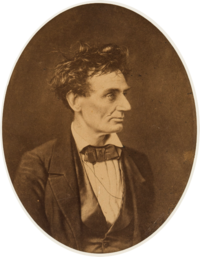 | February 28, 1857 | Alexander Hessler | Chicago, Illinois[7] | Gelatin silverish print from the lost original negative | Library of Congress | I have a alphabetic character from Mr. Hesler stating that [Lincoln] came in and fabricated arrangements for the sitting, so that the members of the bar could get prints. Lincoln said at the fourth dimension that he did non know why the boys wanted such a homely confront. Joseph Medill went with Mr. Lincoln to have the picture taken. He says that the photographer insisted on smoothing down Lincoln's pilus, but Lincoln did not like the result, and ran his fingers through it before sitting. —H. W. Fay of DeKalb, Illinois, original owner of the photo[viii] Lincoln immediately prior to his Senate nomination. The original negative was burned in the Great Chicago Burn.[8] |
 | May 27, 1857 | Amon T. Joslin | Danville, Illinois | Ambrotype[9] | Lincoln Financial Foundation Drove, Allen Canton Public Library | Although some historians have dated this photograph during the court session of Nov 13, 1859, and others have placed it as early on every bit 1853, almost regime at present believe it was taken on May 27, 1857. The lensman Amon T. Joslin owned "Joslin's Gallery" located on the second floor of a edifice adjoining the Woodbury Drug Store, in Danville, IL. This was 1 of Lincoln's favorite stopping places in Vermilion County, Illinois, while he was a traveling lawyer. Joslin photographed Abraham Lincoln twice at this sitting. Lincoln kept one copy and gave the other to his friend, Thomas J. Hilyard, deputy sheriff of Vermilion County. Today, one original resides in the Illinois Country Historical Library.[10] |
 | 1858 | Roderick M. Cole | Peoria, Illinois | Daguerreotype (?)[11] | Benjamin Shapell Family Manuscript Foundation | ... the Photograph you take of Abraham Lincoln is a re-create of a Daguerreotype, that I made in my gallery in this city [Peoria] during the Lincoln and Douglas entrada. I invited him to my gallery to requite me a sitting ... and when I had my plate set, he said to me, 'I cannot see why all you artists want a likeness of me unless it is because I am the homeliest man in the Country of Illinois.'" Lincoln liked this epitome and oft signed photographic prints for admirers. In fact, in 1861, he even gave a re-create to his stepmother. The image was extensively employed on campaign ribbons in the 1860 Presidential campaign, and Lincoln "frequently signed photographic prints for visitors."[12] |
 | 1858 (?) | (unknown) | (unknown) | Tintype[13] | National Lincoln Museum (Former Ford's Theatre)[xiv] | This is the only extant original tintype of Lincoln[14] |
 | 1858 (?) | (unknown) | Ohio (?) | Photographic re-create of a lost daguerreotype[15] | Anthony 50. Maresh drove | A Ceremonious War soldier from Parma, Ohio, was the original owner of this portrait, published in the Cleveland Apparently Dealer on February 12, 1942, from a impress in the Anthony L. Maresh collection. Possibly it is a photographic copy of one of two daguerreotypes, both now lost, taken in Ohio.[xv] |
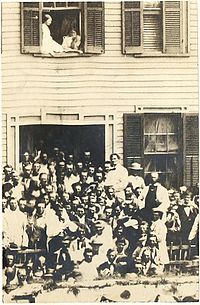 | 1858 (?) | (unknown) | Springfield, Illinois | Photographic re-create | (?) | In 1858, Lincoln squared off against Stephen Douglas for Illinois' Senate seat. The battle sparked seven heated debates on slavery. Here, supporters gather exterior Lincoln's Springfield dwelling house. Lincoln is the tall, white effigy by the doorway.[16] |
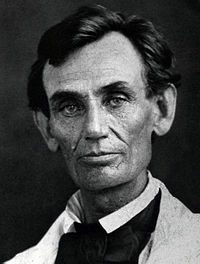 | May 7, 1858 | Abraham G. Byers | Beardstown, Illinois[17] | Ambrotype | University of Nebraska | Formerly in the Lincoln Monument collection at Springfield, Illinois. Mr. Lincoln wore a linen glaze on the occasion. The picture show is regarded as a skillful likeness of him equally he appeared during the Lincoln Douglas entrada.[18] |
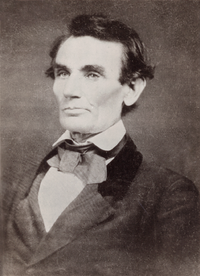 | May 25, 1858 | Samuel One thousand. Alschuler | Urbana, Illinois[19] | Ambrotype | Library of Congress | At the time I was [a young] clerk of the circuit court, and was nearly as well acquainted with Mr. Lincoln as with most of the forty-odd lawyers who practiced police force in the circuit ... On the opening day of court, which was e'er an interesting occasion, largely because we were curious to run across what attorneys from a altitude were in attendance ... I observed that Mr. Lincoln was among them; and as I looked in his management, he arose from his seat, and came forward and gave me a cordial paw-milkshake, accompanying the activeness with words of congratulation on my election. I mention this fact because the deport of Mr. Lincoln was so in dissimilarity with that of the other members of the bar that it touched me securely, and fabricated me, always afterward, his steadfast friend." —C. F. Gunther of Chicago, circa 1896 Alphabetic character[20] One morning I was in the gallery of Mr. Alschuler, when Mr. Lincoln came into the room and said he had been informed that he (Alschuler) wished him to sit for a picture. Alschuler said he had sent such a message to Mr. Lincoln, but he could not have the moving-picture show in that glaze (referring to a linen squeegee in which Mr. Lincoln was clad), and asked if he had not a dark coat in which he could sit. Mr. Lincoln said he had non; that this was the only coat he had brought with him from his home. Alschuler said he could clothing his glaze, and gave it to Mr. Lincoln, who pulled off the duster and put on the artist'south coat. Alschuler was a very short homo, with short arms, but with a trunk most every bit large as the body of Mr. Lincoln. The arms of the latter extended through the sleeves of the glaze of Alschuler a quarter of a yard, making him quite ludicrous, at which he (Lincoln) laughed immoderately, and sabbatum downwards for the pic to exist taken with an effort at being sober enough for the occasion. The lips in the moving-picture show testify this." —Mr. J. O. Cunningham, present when the moving picture was taken[twenty] |
 | July 18, 1858 | Preston Butler[21] | Springfield, Illinois | Gelatin silver impress of a lost carbon enlargement of the lost ambrotype | Library of Congress | This image was presumably taken past Preston Butler the day after Lincoln delivered a voice communication in Springfield in which Lincoln urges that slavery be placed on the class of "ultimate extinction". He attacks Stephen Douglas and defends himself past stating that he supports the principles of equality put forth in the Proclamation of Independence. This speech preceded his debates with Douglas.[22] |
 | August 26, 1858 | T. P. Pearson[23] | Macomb, Illinois | Ambrotype | Library of Congress | Mr. Magie happened to remain over night at Macomb, at the aforementioned hotel with Mr. Lincoln, and the adjacent morning took a walk about town, and upon Mr. Magie's invitation they stepped into Mr. Pierson's establishment, and the ambrotype of which this is a copy was the result. Mr. Lincoln, upon entering, looked at the camera as though he was unfamiliar with such an musical instrument, and so remarked: 'Well, exercise you want to take a shot at me with this thing?' He was shown to a glass, where he was told to 'gear up upwardly,' but declined, saying it would not be much of a likeness if he fixed upwardly whatsoever. The former neighbors and acquaintances of Mr. Lincoln in Illinois, upon seeing this film, are apt to exclaim: 'There! that's the best likeness of Mr. Lincoln that I ever saw!' The wearing apparel he wore in this picture is the same in which he made his famous canvas with Senator Douglas." —J. C. Power, custodian of the Lincoln monument in Springfield[24] |
 | September 26, 1858 | (attributed to Christopher Due south. German)[25] | Springfield, Illinois | Daguerreotype (?) | Chicago History Museum | In 1858 Lincoln and Douglas had a series of articulation debates in this Land, and this city was one place of meeting. Mr. Lincoln'southward step-mother was making her dwelling with my father and mother at that fourth dimension. Mr. Lincoln stopped at our house, and as he was going away my mother said to him: "Uncle Abe, I desire a film of you lot." He replied, "Well, Harriet, when I get home I volition have ane taken for you and send it to you." Soon after, mother received the photograph, which she however has, already framed, from Springfield, Illinois, with a letter from Mr. Lincoln, in which he said, "This is non a very expert-looking flick, merely it'south the best that could exist produced from the poor discipline." He besides said that he had information technology taken solely for my female parent." —Mr. K. Northward. Chapman of Charleston, Illinois, nifty-grandson of Sarah Bush Lincoln[26] |
 | October 1, 1858 | Calvin Jackson[27] | Pittsfield, Illinois | Ambrotype | Library of Congress | On the afternoon of Friday, Oct 1, 1858, Lincoln had a luncheon at the abode of his attorney friend, Daniel H. Gilmer in Pittsfield, Illinois. Lincoln and then headed across the street to the town square, where he spoke for 2 hours. Following the address, Lincoln, at the asking of Gilmer, went to the portable canvass photo gallery of Calvin Jackson on the northeast corner of the square and sabbatum for two ambrotype poses. The photos were before long processed, just one was not finished, probably because it had been overexposed. Lincoln requested that copies of the other be delivered to two Pittsfield friends the post-obit day.[28] |
 | October 11, 1858 | William Judkins Thomson[29] | Monmouth, Illinois | Ambrotype | National Portrait Gallery, Smithsonian Institution | This ambrotype was taken two days before the side by side to last debate with Douglas in Quincy, Illinois.[thirty] |
 | 1859 (?) | (unknown) | Springfield, Illinois | (unknown) | (unknown) | Photo, of unknown origin, shows Abraham Lincoln in Springfield, Illinois, probably in 1859.[31] |
 | October 4, 1859 | Samuel M. Fassett[32] | Chicago, Illinois | Photograph | Negative destroyed in Swell Chicago Fire[33] | Lincoln saturday for this portrait at the gallery of Cooke and Fassett in Chicago. Cooke wrote in 1865 "Mrs. Lincoln pronounced [it] the best likeness she had ever seen of her married man."[33] |
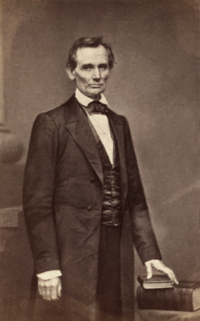 | Feb 27, 1860 | Mathew Brady[34] | New York, New York | Carte-de-visite printed by Brady's gallery from a lost copy negative of a retouched original print | Library of Congress | Mathew Brady's kickoff photograph of Lincoln, on the day of the Cooper Union speech. Over the post-obit weeks, newspapers and magazines gave full accounts of the event, noting the high spirits of the oversupply and the stirring rhetoric of the speaker. Artists for Harper's Weekly converted Brady'due south photograph to a full-folio woodcut portrait to illustrate their story of Lincoln's triumph, and in October 1860, Leslie'south Weekly used the same image to illustrate a story nearly the ballot. Brady himself sold many carte-de-visite photographs of the Illinois pol who had captured the center of the nation. Brady remembered that he drew Lincoln's collar up high to improve his appearance; subsequent versions of this famous portrait also show that artists smoothed Lincoln's pilus, smoothed facial lines and straightened his field of study's "roving" left middle. After Lincoln secured the Republican nomination and the presidency, he gave credit to his Cooper Union spoken communication and this portrait, maxim, "Brady and the Cooper Institute made me President."[35] |
 | 1860 (Spring or Summer) | (unknown) | Illinois (?) | (unknown) | Library of Congress | Contemporary albumen print believed to exist the only surviving likeness printed from the lost original negative made by an unknown photographer, probably in Springfield or Chicago, during the spring or summer of 1860.[36] |
 | May 9, 1860 | Edward A. Barnwell | Decatur, Illinois | Positive printed on glass from a lost original negative or ambrotype[37] | Decatur Public Library | Abraham Lincoln was in Decatur to nourish the Illinois State Republican Convention. Local photographer Edward A. Barnwell wanted to take a picture of "the biggest man" at the convention and invited Lincoln to his People's Ambrotype Gallery at 24 North Water Street to pose for this portrait. The next twenty-four hour period, subsequently Richard Oglesby introduced the "Rail Splitter", convention delegates unanimously endorsed Lincoln for President. On May 18 the National Republican Convention meeting in Chicago nominated him every bit the party's candidate.[38] |
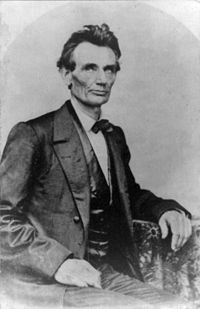 | May 20, 1860 | William Marsh[39] | Springfield, Illinois | Gelatin silverish print copy from the original ambrotype | Library of Congress | Presidential candidate Abraham Lincoln in Springfield, Illinois, 2 days after he won his party's nomination.[40] |
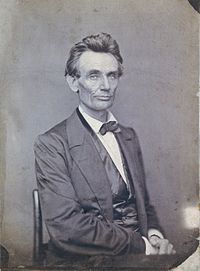 | May xx, 1860 | William Marsh[41] | Springfield, Illinois | Table salt print from glass negative[42] | Metropolitan Museum of Art | One of five photographs taken by William Marsh for Marcus Lawrence Ward. Although many in the E had read Lincoln'south impassioned speeches, few had actually seen the Representative from Illinois.[forty] |
 | June three, 1860 | Alexander Hesler[43] | Springfield, Illinois | Photograph | Library of Congress | Hesler took a total of four portraits at this sitting. Lincoln's law partner William Herndon wrote of this picture show: "There is the peculiar curve of the lower lip, the lone mole on the right cheek, and a pose of the head so essentially Lincolnian; no other artist has ever caught it." [44] |
 | June iii, 1860 | Alexander Hesler[45] | Springfield, Illinois | Photograph | Museum of Fine Arts, Boston | When Lincoln saw this photo, along with his side view portrait from the aforementioned sitting, he remarked "That looks better and expresses me better than whatsoever I have e'er seen; if it pleases the people I am satisfied." [46] |
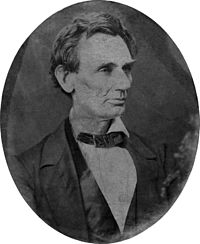 | June three, 1860 | Alexander Hesler[47] | Springfield, Illinois | Photograph | Library of Congress | Lincoln and a Chicago reporter were looking at what is believed to this photo at Lincoln'south domicile presently after his nomination for President, when he observed "That picture gives a very fair representation of my homely face." [48] |
 | June 1860 [49] | (unknown) | Springfield, Illinois | Halftone print, from an albumen print from the lost original negative.[50] | (unknown) | In the summer of 1860 Mr. One thousand. C. Tuttle, a photographer of St. Paul, wrote to Mr. Lincoln, requesting that he take a negative taken and sent to him for local utilise in the campaign. The request was granted, but the negative was broken in transit. On learning of the blow, Mr. Lincoln saturday again, and with the second negative he sent a jocular notation wherein he referred to the fact, disclosed past the film, that in the interval he had "got a new coat". A few copies of the picture were fabricated past Mr. Tuttle, and distributed amid the Republican editors of the State.[51] |
 | 1860 (summer) | William Seavey[52] | Springfield, Illinois | Photograph | (unknown) | After this unmarried print was made, the negative was lost when a fire destroyed the photographer'southward gallery.[53] |
 | 1860 (spring or summer)[54] | (unknown) | Springfield, Illinois | Contemporary albumen print believed to exist the only surviving likeness printed from the lost original negative[55] | Library of Congress | A study of Lincoln's powerful physique, this full-length photograph every bit taken for utilize by sculptor Henry Kirke Brown, and was found amid his furnishings in 1931.[56] |
 | 1860 (spring or summer)[57] | William Shaw | Chicago or Springfield, Illinois | Albumen print from a lost gimmicky negative | Chicago Dominicus Times Archives | This image has been heavily retouched at some point. Lincoln's neck, skin and cheek lines are smoothed out, and the handbag under the right eye has been diminished.[58] |
 | 1860 (summertime)[59] | (unknown) | Springfield, Illinois (?) | Halftone of an albumen print from a lost original negative | Allegheny College | A copy of this paradigm turned up with the effects of artist John Henry Brown, whose watercolor miniature of Lincoln hangs in the National Portrait Gallery.[60] |
 | August 13, 1860 [61] | Preston Butler | Springfield, Illinois | Ambrotype plate 5.75 ten 4.5 inches | Library of Congress | The last beardless photograph of Lincoln.[62] John K. Read commissioned Philadelphia artist John Henry Chocolate-brown to paint a practiced-looking miniature of Lincoln "whether or not the discipline justified information technology". This ambrotype is ane of six taken on Monday, August 13, 1860, in Butler's daguerreotype studio (of which simply ii survive), fabricated for the portrait painter.[63] |
 | November 25, 1860 [64] | Samuel G. Altschuler | Chicago, Illinois | Gelatin silvery print of a carte du jour-de-visite print of what appears to have been a retouched contemporary albumen print supposedly from the lost original negative[65] | Library of Congress | An eleven-year-old girl named Grace Bedell wrote to Lincoln, asking "allow your whiskers grow ... y'all would wait a great deal ameliorate for your face is and so thin. All the ladies like whiskers and they would tease their husbands to vote for you lot and so yous would be President." and the president-elect responded "Equally to the whiskers have never worn any do you not retrieve people would call it a empty-headed amore if I were to brainstorm it at present?" Regardless, the next time he visited his hairdresser William Florville, he appear "Billy, let's requite them a chance to grow."[66] By the time he began his inaugural journeying by train from Illinois to Washington, D.C., he had a full bristles. |
 | Jan 1861 | Christopher South. High german | Springfield, Illinois | ? | ? | ? |
 | February 9, 1861 | Christopher S. German | Springfield, Illinois | Photograph[67] | Library of Congress | This photograph was taken two days before he left Springfield en route to Washington, DC, for his inauguration.[65] |
 | February 9, 1861 | Christopher Due south. German | Springfield, Illinois | Tintype from lost negative[68] | Individual drove | Taken during the aforementioned sitting, this profile reveals the back of Lincoln's head more than mayhap any other portrait.[69] |
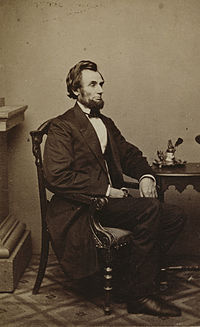 | Feb 24, 1861 | Alexander Gardner[70] | Washington, D.C. | Albumen silver print[71] | J. Paul Getty Museum | Taken during President-elect Lincoln's kickoff sitting in Washington, D.C., the mean solar day afterwards his arrival past railroad train.[72] |
 | March 1, 1861 and June thirty, 1861 (betwixt) | (unknown) | (unknown) | Salt print from the lost original negative[73] | Christie's | The first photographic image of the new president. Remarkably, it is not known where or by whom this portrait was taken; the few known examples carry imprints of several different photographers: C.D Fredericks & Co. of New York; Due west.L. Germon and James E. McLees, both of Philadelphia. This example has been termed "the most valuable Lincoln photo in existence" and sold at auction in 2009 for $206,500.[74] |
 | Apr 6, 1861 [75] | Mathew Brady[76] | Washington, D.C. | Giant regal photo from original collodion plate[77] | Library of Congress | Lincoln'south drooping left eyelid is clearly visible in this image. |
 | May 16, 1861 [78] | Mathew Brady[79] | Washington, D.C. | Solio print of a lost gimmicky albumen print from the lost defective original negative fabricated past an unknown lensman at Mathew Brady's gallery,[lxxx] | Brown Digital Repository | Abraham Lincoln, half-length portrait, seated[81] |
 | May xvi, 1861 [82] | Mathew Brady[83] | Washington, D.C. | Carte du jour-de-visite printed from one frame of the lost original multiple-epitome stereographic negative[84] | Library of Congress | President Abraham Lincoln, seated next to small table, in a reflective pose, May sixteen, 1861, with his hat visible on the table.[85] |
 | Feb 1862 | Mathew Brady | Washington, D.C. | Carte-de-visite | Private Collection | Taken shortly subsequently the death of Lincoln's son Willie. Governor Joseph W. Fifer of Illinois, afterward seeing this epitome, commented "The melancholy seemed to curlicue from his shoulders and drip from the ends of his fingers."[86] |
 | Oct three, 1862 | Alexander Gardner[87] | Antietam, Maryland | Cropped digital file from original wet collodion glass negative | Library of Congress | Lincoln decided to visit the front after Full general McClellan hesitated to attack Robert E. Lee. This picture of Lincoln with McClellan and his officers was taken the morning after the President arrived in Antietam.[88] |
 | October 3, 1862 | Alexander Gardner | Antietam, Maryland | Digital file from original wet collodion drinking glass negative | Library of Congress | Lincoln in McClellan's tent after the Battle of Antietam. |
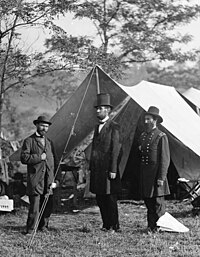 | October three, 1862 | Alexander Gardner[89] | Antietam, Maryland | Cropped digital file from original wet collodion glass negative | Library of Congress | Lincoln with Allan Pinkerton and Major General John A. McClernand at Antietam.[90] The photo was taken in front of the headquarters tent of the U.Due south. Underground Service.[91] |
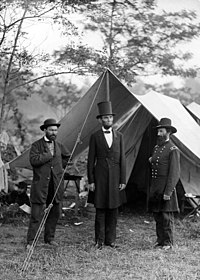 | October iii, 1862 | Alexander Gardner[92] | Antietam, Maryland | Cropped digital file from original wet collodion glass negative | Library of Congress | Lincoln with Allan Pinkerton and Major Full general John A. McClernand at Antietam.[93] |
 | April 17, 1863 | Thomas Le Mere | Washington, D.C. | Carte de Visite | National Portrait Gallery | Mathew Brady Studios' photograph operator, Thomas Le Mere, idea information technology would exist a "considerable call" to capture a full-length portrait of the President. He did so in this instance with a multiple lens photographic camera in Brady's Gallery.[94] |
 | 1863 | Lewis Emory Walker[95] | Washington, D.C. | Collodion glass negative | Library of Congress | Lincoln, seated, with an unbuttoned coat and wearing his standard aureate watch chain, presented to him in 1863 past a California delegation.[96] |
 | August ix, 1863 | Alexander Gardner[97] | Washington, D.C. | Mammoth-size albumen portrait from original negative | Christie'due south Auction, Sale 2272, Lot 86 | Lincoln's "Photographer's Confront". Per Dr. James Miner, "His large bony face when in quiet was unspeakably deplorable and equally unreadable as that of a sphinx, his eyes were every bit expressionless as those of a dead fish; merely when he smiled or laughed at one of his ain stories or that of another then everything about him changed; his figure became alert, a lightning change came over his eyebrow, his eyes scintillated and I idea he had the most expressive features I had always seen on the face of a homo."[98] |
 | August nine, 1863 | Alexander Gardner[99] | Washington, D.C. | Gelatin Silver Print from glass negative | Metropolitan Museum of Art | This is one of a series of six pictures of the President taken past Alexander Gardner on the mean solar day before the official opening of his gallery. Lincoln had promised to be Gardner's commencement sitter and chose Sunday for his visit to avert "curiosity seekers and other seekers" while on his way to the gallery. |
 | August 9, 1863 | Alexander Gardner | Washington, D.C. | Carte de Visite | Heritage Auctions Lot #43062 | Lincoln holds a newspaper in ane hand and his eyeglasses in the other in this autographed Carte de Visite. |
 | August nine, 1863 [100] | Alexander Gardner | Washington, D.C. | Carte de Visite | Heritage Auctions Lot #43025 | Lincoln seated with hands in lap. |
 | Baronial 9, 1863 | Alexander Gardner | Washington, D.C. | Photograph on paper | Skinner's Sale 2658B, Lot 35 | This image from Lincoln's Baronial 1863 sitting with Alexander Gardner in his new studio at seventh and D Street remained in the family of Lincoln'south Secretary John Hay until existence sold at auction in 2013.[101] |
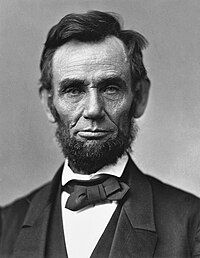 | November eight, 1863 | Alexander Gardner[102] | Washington, D.C. | Matte collodion print | Mead Fine art Museum | This famous image of Lincoln was photographed by Alexander Gardner on November 8, 1863, just weeks before he would deliver the Gettysburg Accost. It is sometimes referred to as the "Gettysburg portrait", although it was really taken in Washington. As Lincoln had previously done in August 1863, he visited Gardner's studio on a Sunday afternoon. He posed for several boosted portraits during this session. |
 | November 8, 1863 | Alexander Gardner | Washington, D.C. | | Meserve-Kunhardt Foundation | Profile image |
 | Nov 8, 1863 | Alexander Gardner[103] | Washington, D.C. | Imperial albumen impress | Sotheby'due south, New York, five October 2011, N08775, Lot 43 | This paradigm emphasizes Lincoln'south big, lanky legs.[104] |
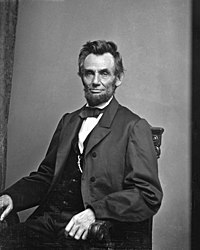 | January eight, 1864 [105] | Mathew Brady | Washington, D.C. | Reproduced from a positive printed on moving picture from a contemporary negative[106] | National Archives | Lincoln visited Mathew Brady's studio in Washington, D.C. on at to the lowest degree three occasions in 1864. Several portraits survive from each session. |
 | January 8, 1864 [107] | Mathew Brady | Washington, D.C. | Overlay of three stereo images from a multiple paradigm stereographic plate | National Archives | This image is an overlay of iii views compiled from a multiple image stereographic plate taken by Brady. |
 | February 9, 1864 [108] | Anthony Berger | Washington, D.C. | Photograph | Library of Congress | "The Penny Contour". Berger was the manager of Mathew Brady'due south Gallery when he took multiple photographs at this Tuesday sitting. In 1909 Victor David Brenner used this image and ane other similar image from this sitting to model the Lincoln cent.[109] |
 | February 9, 1864 [110] | Anthony Berger | Washington, D.C. | Carte de Visite | Heritage Auction #43032 | A rare collodion plate of this image in full is housed in the National Archives |
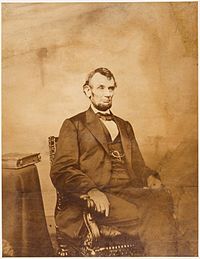 | Feb 9, 1864 | Anthony Berger | Washington, D.C. | Royal albumen print | Heritage Auction #43034 | In 1895 Robert Todd Lincoln wrote "I have always thought the Brady photo of my father, of which I attach a copy, to be the most satisfactory likeness of him."[111] |
 | Feb 9, 1864 [108] | Anthony Berger | Washington, D.C. | Photograph | National Archives | An original cracked plate, just under the size known as "imperial".[112] The Lincoln portrait on the current U.s. five-dollar bill is based on this photograph. |
 | February 9, 1864 | Anthony Berger (?) | Washington, D.C. | Photograph | National Archives | Presumably taken at the same session as the iv images but higher up. |
 | February 1865 | Lewis Emory Walker[113] | Washington, D.C.[114] | Albumen silver print | Library of Congress | The short haircut was perhaps suggested by Lincoln's barber to facilitate the taking of his life mask by Clark Mills. Lincoln knew from experience how long hair could cling to plaster. From an 1865 stereograph long attributed to Mathew Brady, was actually taken by Lewis Emory Walker, a government photographer, about Feb 1865 and published for him by the E. & H. T. Anthony Co., of New York.[115] |
 | February 5, 1865 | Alexander Gardner[116] | Washington, D.C. | Albumen Argent Print | J. Paul Getty Museum | Abraham Lincoln with his youngest son Tad, taken ten weeks before the President was assassinated. |
 | February 5, 1865 | Alexander Gardner[117] | Washington, D.C. | Gelatin silver print of a carte-de-visite printed from one frame of the lost original multiple-epitome stereographic negative.[118] | Library of Congress | See below. |
 | February v, 1865 | Alexander Gardner[119] | Washington, D.C. | Card-de-visite printed from one frame of the lost original multiple-prototype stereographic negative.[118] | Library of Congress | See below. |
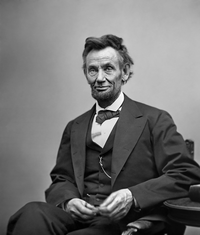 | February 5, 1865 | Alexander Gardner[120] | Washington, D.C. | Gelatin silver print of a lost catamenia print of the multiple-image stereographic pose[121] | Library of Congress | This photograph of Lincoln was made when the brunt of the presidency had taken its toll. President Lincoln visited Gardner'due south studio one Sunday in February 1865, the terminal year of the Civil War, accompanied by the American portraitist Matthew Wilson. Wilson had been commissioned to pigment the president's portrait, but considering Lincoln could spare then little time to pose, the artist needed recent photographs to piece of work from. The pictures served their purpose, simply the resulting painting- a traditional, formal, bust-length portrait in an oval format—is not particularly distinguished and hardly remembered today. Gardner's surprisingly candid photographs take proven more enduring, even though they were non originally intended to stand up alone every bit works of art.[122] |
 | February 5, 1865 | Alexander Gardner[123] | Washington, D.C. | Only surviving print from a glass negative that was accidentally croaky during processing and thrown away[124] | National Portrait Gallery, Washington | According to Frank Goodyear, the National Portrait Gallery'southward photo curator, "This is the last formal portrait of Abraham Lincoln before his assassination. I really like it because Lincoln has a hint of a grin. The inauguration is a couple of weeks abroad; he tin sympathize that the war is coming to an end; and here he permits, for one of the first times during his presidency, a hint of better days tomorrow." [124] |
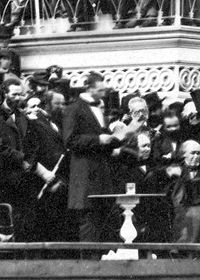 | March four, 1865 | Alexander Gardner | Washington, D.C. | i photographic print: albumen silver | Library of Congress | Cropped portion of Lincoln delivering his 2nd inaugural accost, which is the only known photo of the result. Lincoln stands in the center, with papers in his hand, on the east front end of the Usa Capitol. |
 | March 6, 1865 | Henry F. Warren | Washington, D.C. | 1 photographic print: albumen silver | Library of Congress | The last known high-quality photograph of Lincoln alive, on a balcony at the White House. Two other poses were taken, some other sitting pose and a standing pose, none of which survive. Besides this print, no other negatives or prints survive from this shoot. |
0 Response to "Abe Lincon Clip Art Huge Amount of People Clipart"
Post a Comment