what act gave parliament the right to make any laws they wished to regulate the colonies
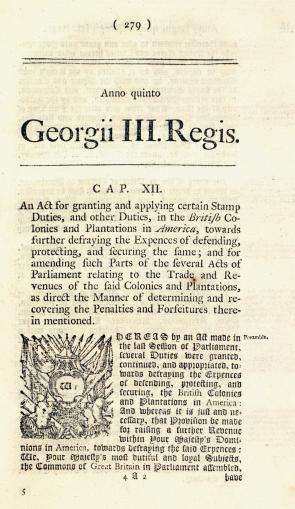 On March 22, 1765, the British Parliament passed the "Stamp Act" to aid pay for British troops stationed in the colonies during the Seven Years' State of war. The deed required the colonists to pay a revenue enhancement, represented past a stamp, on various forms of papers, documents, and playing cards. It was a direct tax imposed by the British authorities without the approval of the colonial legislatures and was payable in hard-to-obtain British sterling, rather than colonial currency. Further, those defendant of violating the Stamp Human activity could be prosecuted in Vice-Admiralty Courts, which had no juries and could be held anywhere in the British Empire.
Of import dates in the Stamp Act Crunch
- March 22, 1765: British Parliament passes the "Stamp Human action."
- October 1765: Delegates from nine colonies encounter in New York City in what has become known every bit the Postage stamp Act Congress, the commencement united action past the colonies; the congress acknowledges that while Parliament has a correct to regulate colonial trade, information technology does non have the ability to tax the colonies since they were unrepresented in Parliament.
- Nov 1, 1765: The Stamp Act goes into effect in the colonies.
- March 1766: Colonial resistance to the Stamp Human action and pressure from London merchants prompt Parliament to abolish the Stamp Human action.
- March 1766: Parliament problems the Declaratory Act, which states that the king and Parliament have full legislative power over the colonies.
Excerpts
King George Iii, An Act for granting and applying sure stamp duties, 1765
An act for granting and applying certain postage stamp duties, and other duties, in the British colonies and plantations in America, towards further defraying the expences of defending, protecting, and securing the same; and for amending such parts of the several acts of parliament relating to the trade and revenues of the said colonies and plantations, as direct the manner of determining and recovering the penalties and forfeitures therein mentioned.
WHEREAS by an human action made in the terminal session of parliament, several duties were granted, continued, and appropriated, towards defraying the expences of defending, protecting, and securing, the British colonies and plantations in America: and whereas it is merely and necessary, that provision be made for raising a further acquirement inside your Majesty's dominions in America, towards defraying the said expences: we, your Majesty's near dutiful and loyal subjects, the commons of United kingdom in parliament assembled, have therefore resolved to requite and grant unto your Majesty the several rates and duties herein after mentioned; and practise most humbly beseech your Majesty that it may be enacted, and be information technology enacted by the King's most excellent majesty, by and with the communication and consent of the lords spiritual and temporal, and commons, in this present parliament assembled, and by the dominance of the same, That from and later on the first twenty-four hours of November, thou vii hundred and 60 five, there shall be raised, levied, collected, and paid unto his Majesty, his heirs, and successors, throughout the colonies and plantations in America which now are, or hereafter may be, under the dominion of his Majesty, his heirs and successors,
For every skin or piece of vellum or parchment, or sheet or slice of paper, on which shall be ingrossed, written, or printed, any licence, engagement, or admission of any counsellor, solicitor, attorney, advocate, or proctor, to exercise in any court, or of any notary inside the said colonies and plantations, a stamp duty of ten pounds.
For every pare or piece of vellum or parchment, or sheet or piece of newspaper, on which shall be ingrossed, written, or printed, any notation or pecker of lading, which shall be signed for any kind of goods, wares, or merchandize, to be exported from . . . within the said colonies and plantations, a stamp duty of four pence.
For every skin or piece of vellum or parchment, or canvas or piece of paper, on which shall be ingrossed, written, or printed, any licence for retailing of wine, to be granted to any person who shall have out a licence for retailing of spirituous liquors, inside the said colonies and plantations, a stamp duty of three pounds,
For every skin or slice of vellum or parchment, or sheet or piece of paper, on which shall be ingrossed, written, or printed, any notarial human action, bond, deed, letter of the alphabet, of attorney, procuration, mortgage, release, or other obligatory instrument, non herein before charged, within the said colonies and plantations, a stamp duty of two shillings and three pence.
And for and upon every pack of playing cards, and all dice, which shall be sold or used within the said colonies and plantations, the several stamp duties post-obit (that is to say)
For every pack of such cards, the sum of one shilling.
And for every pair of such dice, the sum of x shillings.
And for and upon every paper, commonly called a pamphlet, and upon every newspaper, containing publick news, intelligence, or occurrences, which shall be printed, dispersed, and made publick, within whatever of the said colonies and plantations, and for and upon such advertisements as are herein after mentioned, the respective duties following (that is to say)
For every other almanack or calendar for any one particular year, which shall be written or printed within the said colonies or plantations, a stamp duty of four pence. . . .
A re-create of the excerpts is available.
Source: https://www.gilderlehrman.org/history-resources/spotlight-primary-source/stamp-act-1765
0 Response to "what act gave parliament the right to make any laws they wished to regulate the colonies"
Post a Comment